
Aluminum Alloy vs. Stamped Steel Chair Bases: A Manufacturer’s Comparison for B2B Buyers

This question comes up in almost every new supplier conversation: should we go with aluminum alloy or stamped steel chair bases for this project?
It sounds like a simple materials question. In practice, it pulls in production cost, shipping weight, finish options, certifications, end-market positioning, and MOQ calculations all at once. There is no universal right answer — but there are clear frameworks for thinking through it, and the choice is usually more predictable than it feels at the start.
What follows is how we think about it from the manufacturing side, having produced both at volume for buyers across North America, Europe, and Southeast Asia.
First, a clarification on terminology
The comparison is often framed as “aluminum vs. steel,” but that shorthand covers two genuinely different manufacturing processes that happen to involve different materials. Getting the process distinction right matters because it changes how you evaluate cost, quality consistency, and customization scope.
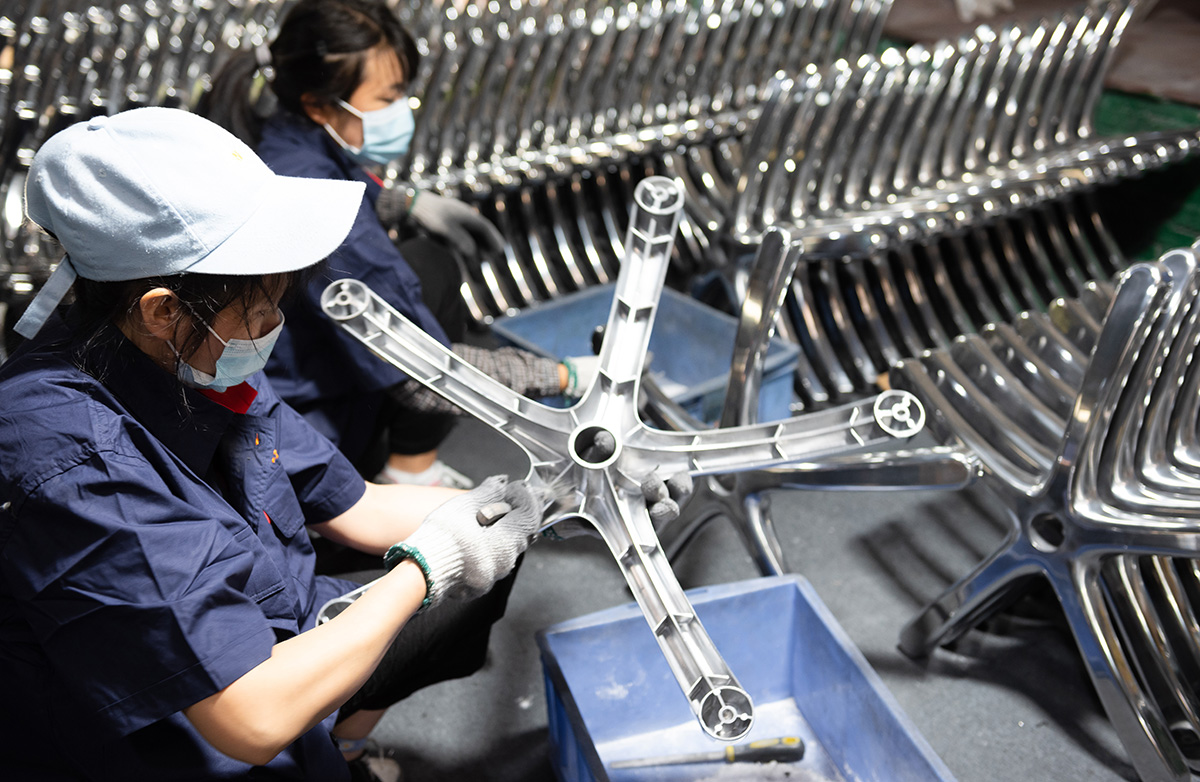
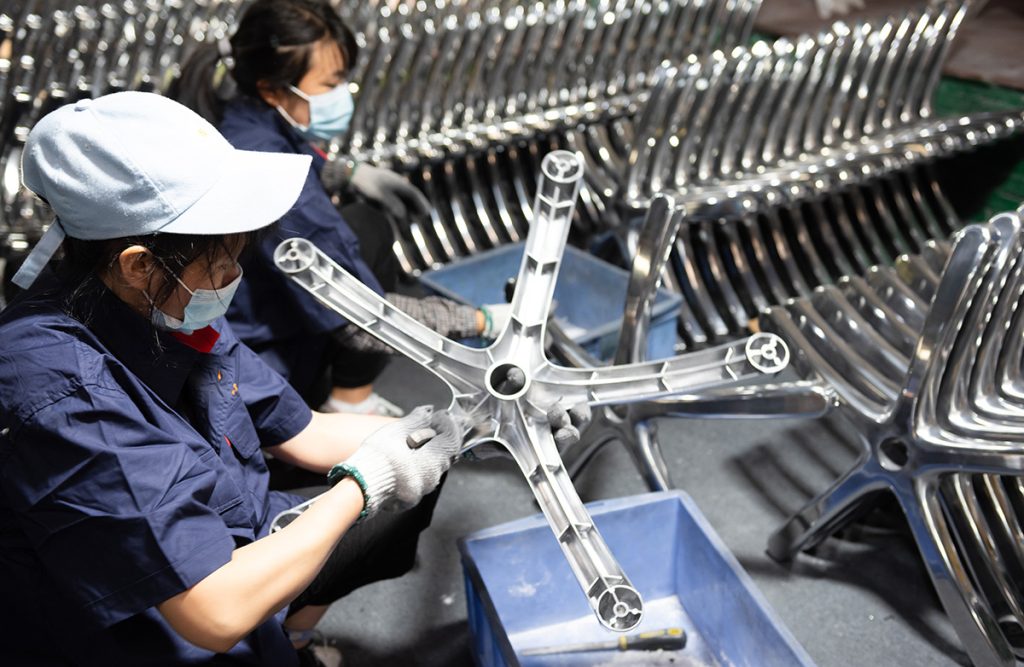
Aluminum alloy bases are produced by die casting: molten aluminum alloy (typically A380 or ADC12, both silicon-magnesium blends) is injected into a steel mold under high pressure. The result is a near-net-shape component that comes out of the die already close to its final dimensions, with a dense grain structure and smooth surface. Post-casting steps are deburring, polishing, and surface treatment.
Stamped steel bases (what most people mean when they say “iron foot” or “五星铁脚”) are produced by cold stamping sheet carbon steel into individual arm profiles, then welding those arms to a central hub. The one-piece stamped variant — where each arm is formed from a single steel blank without separate welding at the hub joint — is a more recent development and performs differently from the welded-hub construction.
Chrome-plated “iron bases” are a subset of the stamped steel category, where the finished steel base is plated with a thin chromium layer. They look different from powder-coated steel but are mechanically similar.
These distinctions matter because “aluminum” is not automatically better than “steel,” and vice versa. The right question is which process and material combination suits the specific application.
Structural performance: where each material actually leads
Weight-to-strength ratio
Aluminum alloy at roughly 2.7 g/cm³ density is about one-third the weight of carbon steel at 7.8 g/cm³. A typical 350mm five-star aluminum base will weigh 700–900g; an equivalent steel base runs 1.4–1.8kg. For a furniture brand shipping flat-pack chairs in container loads, that difference adds up quickly in freight cost per unit.
The strength comparison is more nuanced. Aluminum alloy’s bending strength through die casting can reach approximately three times that of ordinary mild steel — not because aluminum is intrinsically stronger, but because die casting produces a denser, more uniform internal structure than cold-stamping and welding. A well-produced aluminum base will not yield under normal commercial use loads.
That said, steel has a higher absolute tensile strength ceiling and handles impact loading differently. A steel base bent by a sharp impact will typically deform plastically (bend without breaking). A thin-walled aluminum casting hit with the same force may crack at stress concentrations. For high-traffic commercial environments — hospitality, healthcare, 24-hour operations — the question is not which is “stronger” in lab terms, but which failure mode is safer and which is easier to detect before it becomes a safety incident.
Load-bearing capacity and BIFMA compliance
ANSI/BIFMA X5.1 is the standard reference for seating load capacity in the North American market; EN 1335 is the European equivalent. Both specify static load tests and impact tests for the base and overall chair structure.
High-quality aluminum die-cast bases comfortably meet BIFMA X5.1 requirements, with well-designed units supporting 150kg and above under static load. Stamped steel bases, particularly the one-piece formed variant, also meet BIFMA requirements and can be engineered to handle heavier users through material gauge selection.
The variable that matters more than the base material itself is the cylinder socket interface — the central bore where the gas lift inserts. A loose or imprecisely machined socket causes the cylinder to wobble, which creates the sensation of instability that buyers associate with a low-quality base. This is a manufacturing precision issue, not a materials issue, and it affects aluminum and steel bases equally.
Corrosion resistance
Aluminum forms a natural oxide layer that provides inherent corrosion resistance without additional treatment. In humid environments or applications where the base may be exposed to cleaning chemicals (healthcare seating, for example), bare aluminum holds up better than bare steel.
Steel without surface treatment rusts. The practical fix is powder coating, which seals the steel surface and, when properly applied, provides adequate corrosion protection for most commercial environments. The concern with powder-coated steel is chip resistance: a mechanical impact that scratches through the coating exposes the steel underneath to oxidation. In high-use environments where chairs are frequently moved across hard floors, this is worth factoring in.
Manufacturing process implications
Consistency across large runs
Die casting, once the tooling is set and the process parameters are dialed in, produces highly consistent parts. Dimensional variation between units is minimal, surface finish is repeatable, and the cycle time per unit (typically 90–150 seconds) is predictable. This makes aluminum die casting well-suited for large volumes where quality consistency is critical — a brand supplying 10,000 chairs to a corporate client cannot have base-to-base variation that results in visible height or splay differences.
Stamped steel has its own consistency advantages: sheet steel gauge is highly controlled, stamping dies produce repeatable profiles, and the individual arms are dimensionally uniform. The variable in welded-hub construction is weld quality, which depends on operator skill or the calibration of robotic welding equipment. One-piece stamped construction eliminates the hub weld entirely, which removes that variable — and is one reason the one-piece format commands a premium over welded-hub steel bases in quality-conscious markets.
Surface finish options
Aluminum accepts a wider range of aesthetic finishes than steel:
- Polished (mirror or satin)
- Brushed (unidirectional grain)
- Powder coated (any RAL color)
- Anodized (for specific color requirements without paint)
- Chrome electroplated
Steel bases are typically powder coated or chrome plated. Matte black powder coat on steel is the dominant gaming chair finish and is cost-effective. The challenge with steel is achieving a consistent polished look without additional plating, which adds cost and lead time.
For brands where the base is a visible design element — executive task chairs, premium dining chairs, hospitality seating — aluminum’s finish versatility is a genuine advantage. For applications where the base will sit under a desk and not be directly visible to the user, the finish range matters less.
Tooling and customization
Both materials support custom arm profiles, splay angles, and center bore dimensions. The tooling investment differs:
A die casting die for an aluminum base is a significant upfront cost but amortizes quickly over volume. Changes to the design require modifying or replacing the die, which adds time and cost mid-project.
Stamping dies for steel are generally less expensive than casting dies for equivalent complexity. Welding jigs and fixtures add to the tooling cost for welded-hub designs. One-piece stamped designs may require more elaborate blanking dies to achieve the arm profile in a single pass.
For a brand ordering 2,000–5,000 units of a new design, the tooling cost per unit on aluminum may be higher than steel in absolute terms, but the finish quality and part consistency often justify the difference for mid-to-premium market positioning.
Cost structure: the honest breakdown
Neither material is uniformly cheaper. The cost comparison depends on volume, specification, finish, and where in the range of each material you are looking.
Unit cost at volume: A standard 350mm five-star aluminum die-cast base in polished or powder-coated finish will typically carry a higher unit price than an equivalent stamped steel base in the same finish at the same volume. The gap narrows as volume increases, because aluminum’s per-unit manufacturing cost drops faster with scale.
Freight cost: A set of five aluminum bases (enough for one chair) might weigh 750g versus 1.5kg for steel. On an ocean freight order of 10,000 chair sets, that 750g difference per unit translates to roughly 7.5 metric tons — meaningful at container-load pricing.
Total cost of ownership considerations: In end markets with strong ergonomic compliance requirements (Germany, Scandinavia, parts of the U.S. enterprise market), a base that presents and feels premium reduces return rates and warranty claims. If the aluminum base’s higher unit cost results in measurably lower field defect rates, the math can favor aluminum on a 3-year product cycle even if it costs more per unit upfront.
Which market segment uses which, in practice
This is where the abstract comparison becomes concrete. Looking at current ordering patterns:
Aluminum alloy bases are the dominant choice for:
- Premium ergonomic office chairs targeting enterprise buyers or ergonomics-focused consumers
- Executive task chairs where the base is visible and aesthetics matter
- Medical and dental seating where corrosion resistance and cleanability are required
- Chairs priced at retail above approximately USD 300, where the cost of aluminum is well within the margin
- Export to Germany and Northern Europe, where buyers scrutinize component quality
Stamped steel bases (especially one-piece formed) are the dominant choice for:
- Gaming chairs, where matte black powder coat is the expected finish and structural strength matters more than weight
- Commercial seating for high-traffic applications (stadiums, waiting areas) where impact resistance and repairability are valued
- Mid-market office seating in the USD 100–250 retail range where cost structure is tight
- Markets in Southeast Asia and parts of Latin America where freight economics favor lighter-weight alternatives to heavier steel but full aluminum premiums are not yet standard
The hybrid specification — an aluminum alloy base with a heavier wall thickness than a standard polished unit — is increasingly common for buyers who want the finish versatility of aluminum with the structural resilience closer to steel. This requires explicit discussion with the manufacturer about alloy grade and section thickness, not just a catalog order.
What to ask a manufacturer before you decide
If you are currently sourcing or re-specifying chair bases and working through this decision, the questions that actually clarify the choice:
- What alloy grade is the aluminum? A380 and ADC12 are common food-grade die casting alloys with good mechanical properties. If the answer is vague or refers to “recycled aluminum” without further specification, that is a flag — alloy purity directly affects structural performance and crack resistance.
- What is the wall thickness at the arm cross-section? Thin-walled aluminum saves material cost but reduces impact tolerance. For a standard commercial application, 3.5–4mm minimum wall thickness on the arm profile is a reasonable reference point.
- For steel bases: is this a one-piece stamped design or a welded hub? One-piece is more consistent and typically more expensive. If it is welded, ask about weld inspection protocols — visual only, or does the base go through a load test before leaving the line?
- What BIFMA documentation is available? A reputable manufacturer should be able to provide SGS or equivalent static load and impact test reports, not just a certificate stating compliance. The report will show the actual test parameters and results.
- What is the standard finish, and what is the process for a custom finish? The answer tells you how flexible the manufacturer’s process is and what lead time and MOQ implications come with a non-standard specification.
The practical summary
Aluminum and steel chair bases are not interchangeable, but they overlap more than the marketing positioning of each material suggests. For most commercial seating applications, a well-produced version of either material will meet BIFMA structural requirements and perform acceptably over a multi-year product lifecycle.
The decision comes down to finish requirements, end-market pricing position, freight economics, and what happens at the edges — high-load users, corrosive environments, high-traffic installations where impact loading is frequent.
The most common mistake is treating material selection as a cost decision alone. A steel base specified incorrectly for a premium ergonomic chair underperforms in ways that damage the brand. An aluminum base over-engineered for a budget task chair adds cost that the market won’t pay for. Getting the specification right requires understanding both what the chair is selling at and what environment it will actually sit in.
OneNest Furnitech manufactures both aluminum alloy die-cast and one-piece stamped steel chair bases across our Foshan production facility. Standard SKUs are available for evaluation, and we support custom mold development for both materials. SGS test reports are available on request.